

Back to resources
Actual Zero Standing Privileges Comes from an Agentless Architecture
November 2025 / 9 min. read /
Last updated: July 2026
If true Zero Standing Privileges (ZSP) is the goal, two things have to be true at the same time:
- No latent standing privilege. Permissions shouldn’t exist between tasks.
- Runtime authorization. When access is needed, rights are created just-in-time, scoped to the task, and removed automatically.
That’s straightforward on paper and hard in practice, especially now that identities include agentic AI systems that act continuously and at speeds that previous access management platforms weren't intended to handle, in addition to humans and service accounts.
One place the model often breaks is confusing the control of credentials with the control of authorization.
Vaults and credential rotation are important, but they don’t, by themselves, eliminate standing privilege. If a permanent privileged principal has to exist on the target, like an admin role in an account, or a shared service account in a database, then risk persists even if the credential is carefully time-boxed (which isn’t true ZSP).
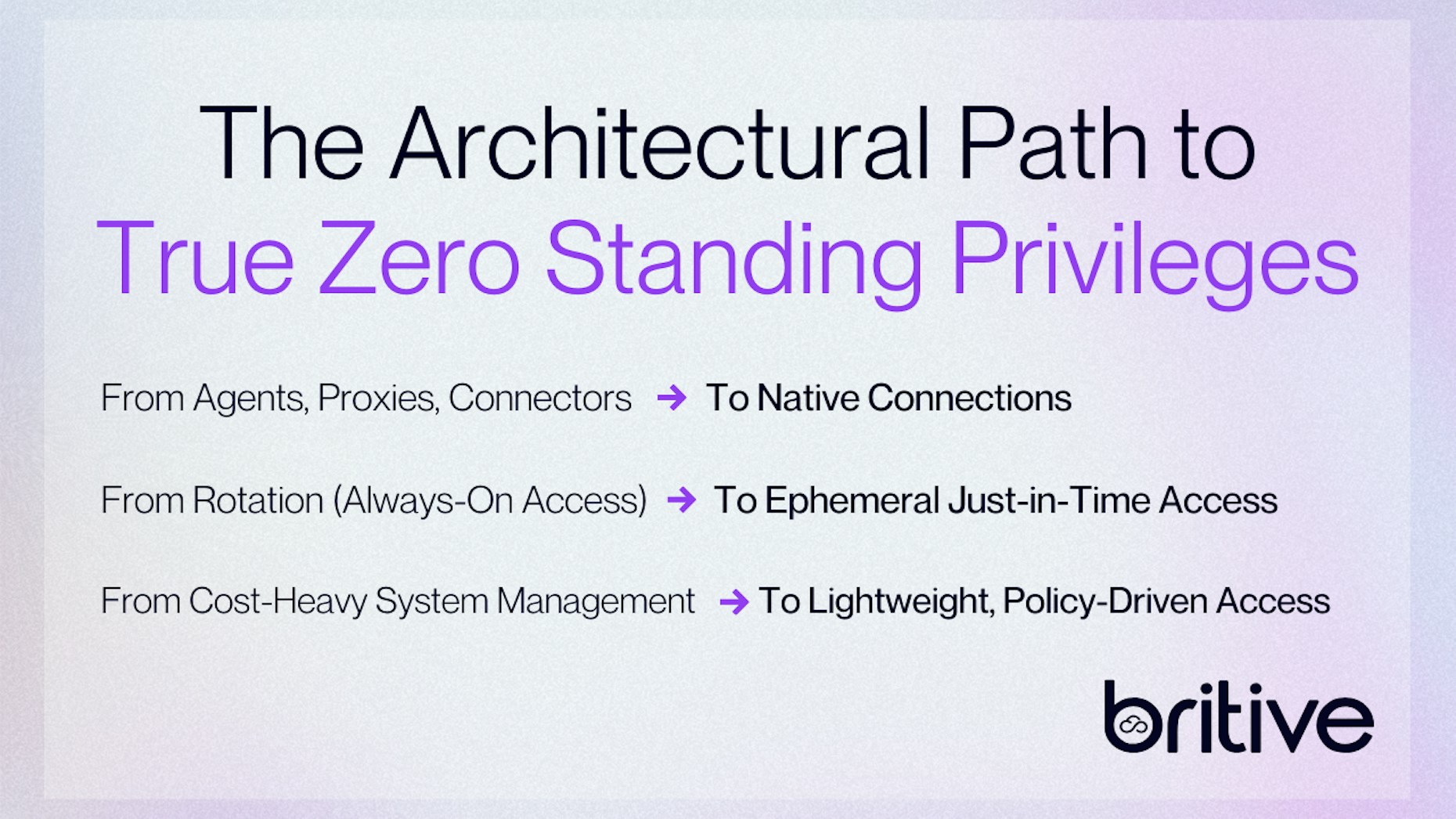
ZSP in the name of Zero Trust requires us to move the unit of control from the credential itself to the permission on the target system, and to do it in a way that doesn’t slow teams down with proxies, agents, or connector projects. ZSP works hand-in-hand with just-in-time (JIT) ephemeral access to ensure that environments stay secure without compromising on speed and security.
Agentless, cloud-native deployments keeps the platform out of your data path to remove operational drag.
Authorization that isn't dependent on vaults ensures permissions only exist during the approved window to remove residual privileges.
Vaults remain useful for secrets that can’t remain ephemeral, but more on that below.
Agentless vs Non-Agentless Infrastructure
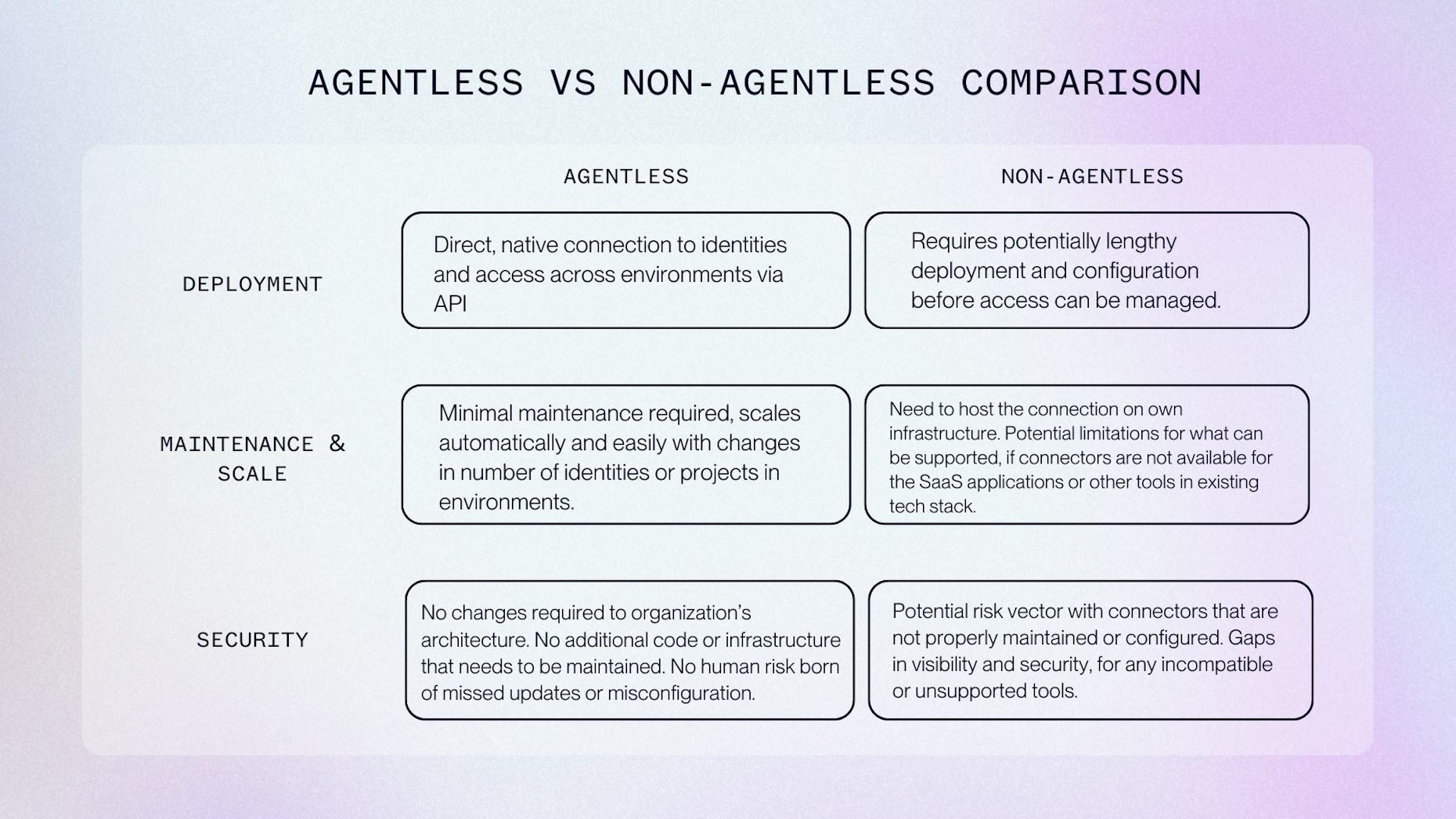
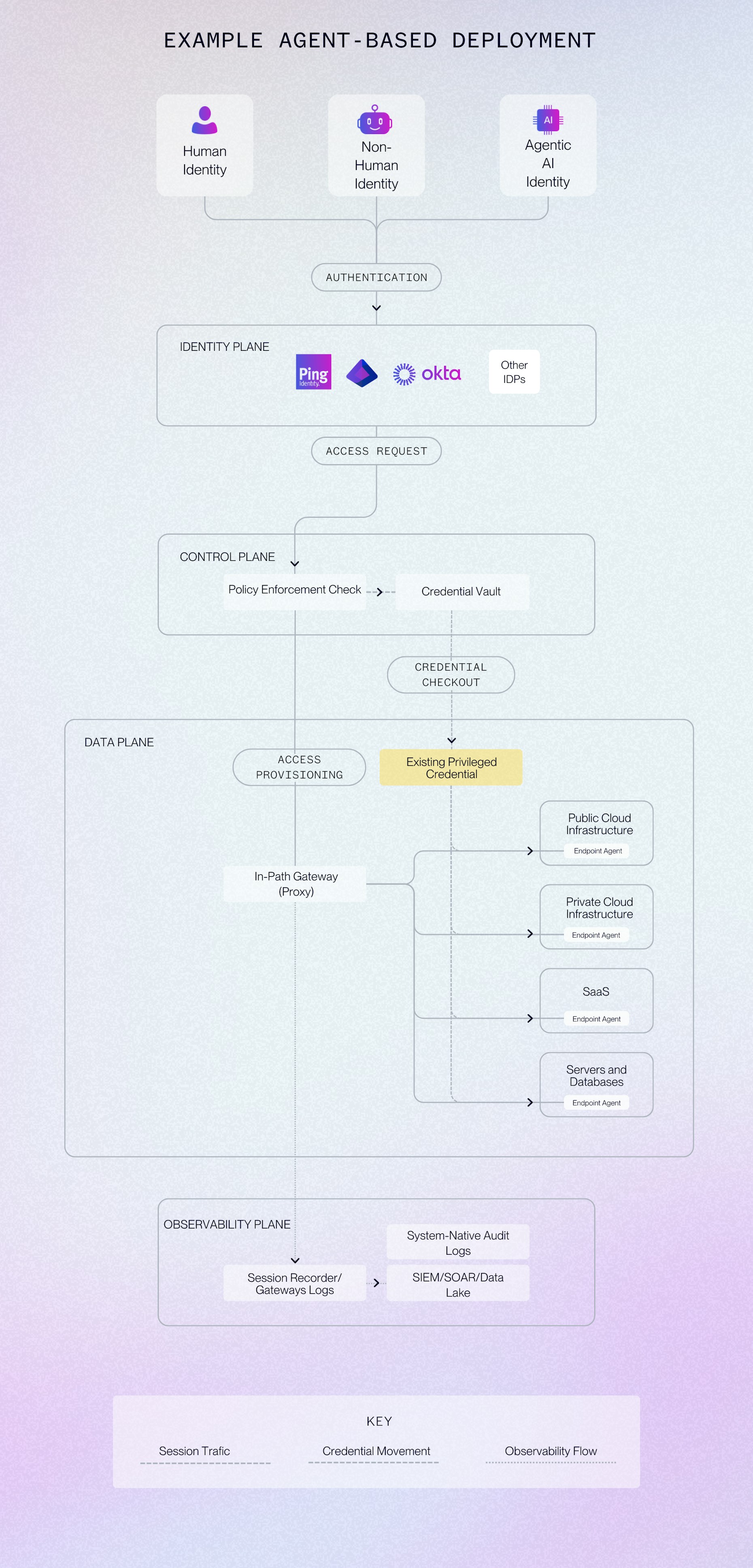
An agentless approach keeps the platform out of the data path. It connects to clouds, SaaS, databases, and clusters using native connections to create and remove permissions on those systems. Sessions flow directly between requesters and targets; the platform doesn’t proxy traffic and doesn’t require host or cluster agents to mediate actions.
As accounts, projects, and identities grow, there’s very minimal added surface to patch or upgrade by way of software, because enforcement happens through the systems you're already operating in.
A non-agentless approach inserts components (e.g. session proxies/jump boxes, endpoint or cluster agents, or a growing set of custom connectors) into the middle of access. This often starts with a straightforward deployment plan that becomes a long-running operational commitment: versioning agents, hardening and scaling proxies, and mapping each system to the right connector.
Each new target or capability can multiply the moving parts you now own. The effect on security posture mirrors the effect on operations: more components to configure correctly, more places where a missed update or a subtle setting can create a gap.
Where Do Vaults Fit In?
Vaults remain useful for the secrets that truly must exist, but they shouldn’t be the center of the access model. When authorization is minted on the target system at runtime, a vault is no longer needed for most operational access paths.
Instead of gating a permanent admin identity, you grant the exact permission required for the task and remove it when the window closes.
Deploying an access management that isn’t reliant on endpoint agents removes the operational and architectural friction; permission-centric control removes the residual privilege. Together, they let the access layer match the speed and scale of the environment it protects.
Supporting Zero Standing Privileges with Agentless, True Just-in-Time Architecture
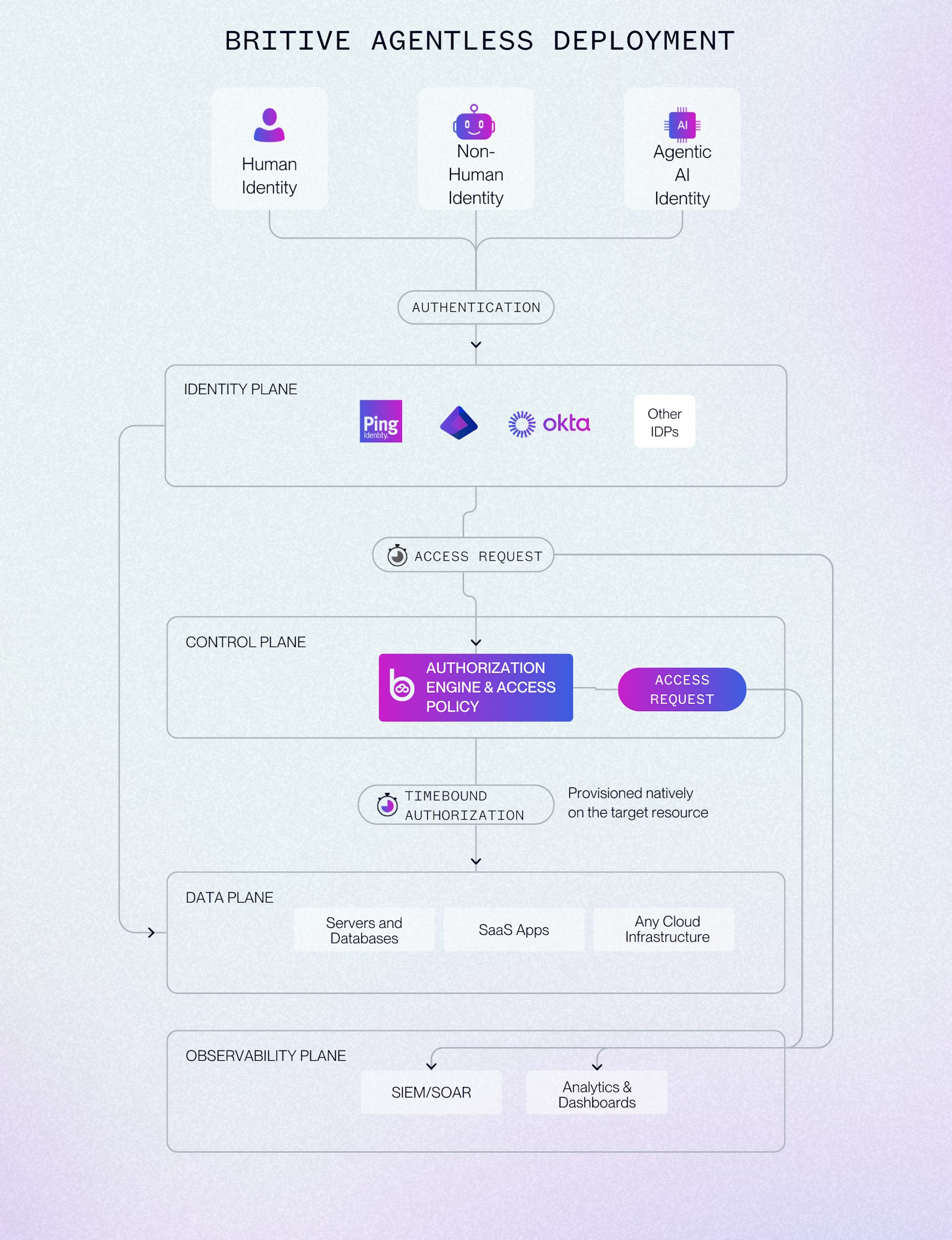
ZSP becomes achievable when the access flow looks like this:
- A user, service account, or AI agent requests access. Policy automatically evaluates identity, purpose, and context, with optional approval for sensitive actions. All of this is done at runtime when the access request is made.
- If approved, the platform leverages native connections to create a scoped, time-bound permission on the target. For example, an AssumeRole in a cloud account, a RoleBinding in a Kubernetes cluster, or a fine-grained database grant.
- The requesting identity connects directly to the target. There’s no proxy or jump service in the path.
- When the window of time ends or a signal is received, the permission is removed and baseline access associated with the identity's account returns to zero. Logs automatically track who accessed what, when, and why to understand the permissions granted and the actions taken.
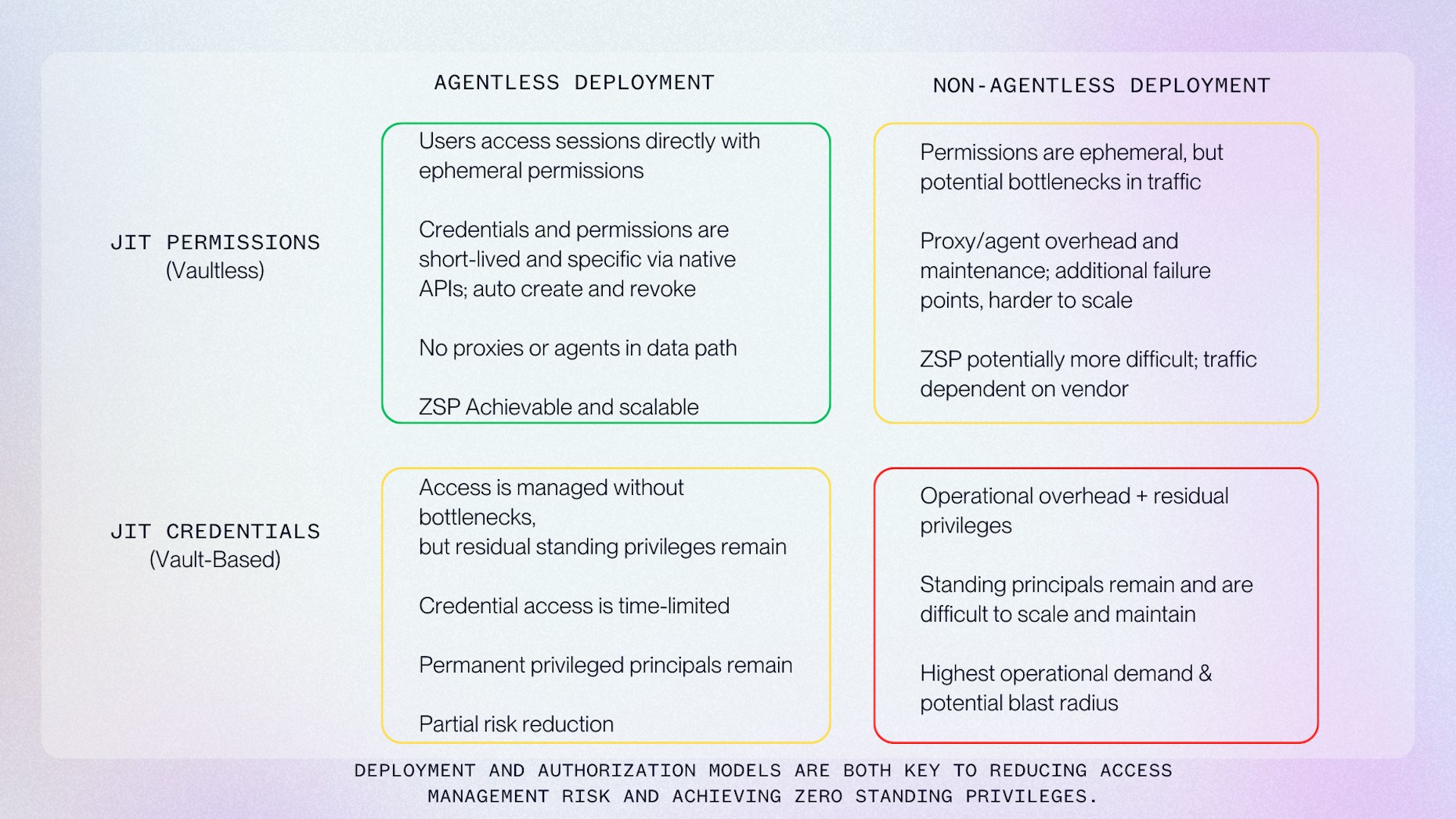
That sequence is the practical difference between vaulted and vaultless just-in-time models.
Vaulted workflows have access to a credential that represents a permanent privileged principal. Permissions on the target system persist, whether anyone is using it or not.
Vaultless workflows limit the time of existence on the permission itself; the authorization exists only during the approved window. In the first case, you’re minimizing exposure to something that’s always there. In the second, you’re removing the thing that would otherwise be exposed.
Permissions are born upon approval and automatically expire on schedule, meaning that credentials or tokens without matching authorization become inert. And because there are no endpoint agents mediating behavior, there’s less code to roll out and fewer emergency changes that need to be made on individual components.
This also solves a long-standing problem for non-human and agentic AI identities. The platform grants the precise permission needed for the task at hand. The job runs and permissions are removed when the job is completed.
The result is fast automation without the always-on service accounts and broad scopes that undermine least privilege.
Scale Access with a Practical Path to ZSP
The goal isn’t simply to mediate access more neatly; it’s to erase privilege that exists between tasks. An agentless achitecture and deployment model keeps the access layer out of the way of normal workflows and out of the center of your incident surface. A vaultless, JIT approach ensures authorization only exists when it should.
Together, they deliver fast rollout, straightforward operations, and a measurable reduction in residual risk for ZSP that holds up under real workloads for people, services, and AI systems alike.



Britive Team
View All PostsView All Posts