


Shifting From Vault-Centric Gating to Runtime Zero Standing Privileges
Delinea and traditional PAM gate the path to privileges that always exist on your resources. Britive handles authorization at the grant layer, minting ephemeral access at runtime and leaving an empty attack surface between tasks.
Book a modernization workshop







Britive is architected for the Cloud. Not the Vault.
Britive creates privilege at the moment of work and removes it when the work ends, for human, agentic AI, and non-human identities. No vault sprawl to maintain, no rotation to staff, no per-seat math that climbs every renewal.
Platforms built on vaults, proxies, and connectors work the other way around: access lives in stored secrets and routed sessions, so every new environment means another connector to deploy, another rotation schedule to run, another integration to maintain. The credential persists whether or not work is happening, and so does the risk.
With Britive there is no endpoint agent to install, no proxy to route through, and nothing standing for an attacker to find.

Align Your Access Strategy With Modern Infrastructure
Scales without operational overhead
Vault-and-proxy architectures grow by adding connectors and infrastructure for every new environment, and the maintenance grows with them. Britive operates through native cloud APIs. A new account, project, or subscription inherits policy automatically; there is nothing to deploy.
Lower TCO cost by ~55%+
The license fee is only part of what a PAM platform costs. Manual rotation, manual access workflows, and multiple admin consoles are labor, every quarter. Britive automates the access lifecycle and fits into the pipelines and tools your teams already run, so the operating cost drops with the risk.
Runtime Zero Standing Privileges by default
A vault protects the credential, but the privilege behind it persists between sessions. Britive removes the privilege itself when the session ends. A compromised identity has nothing to carry, and every access decision is logged as it happens.
One Policy Model. Every Identity.
Vault-based suites grew by acquisition, so policy, administration, and audit work differently from one module to the next, and structuring permissions at scale invites over-permissioning. Britive applies a single policy model to human, agentic AI, and non-human identities across cloud, hybrid, and on-prem. Policies are reusable patterns rather than one-off configurations, and every grant lands in one audit trail.
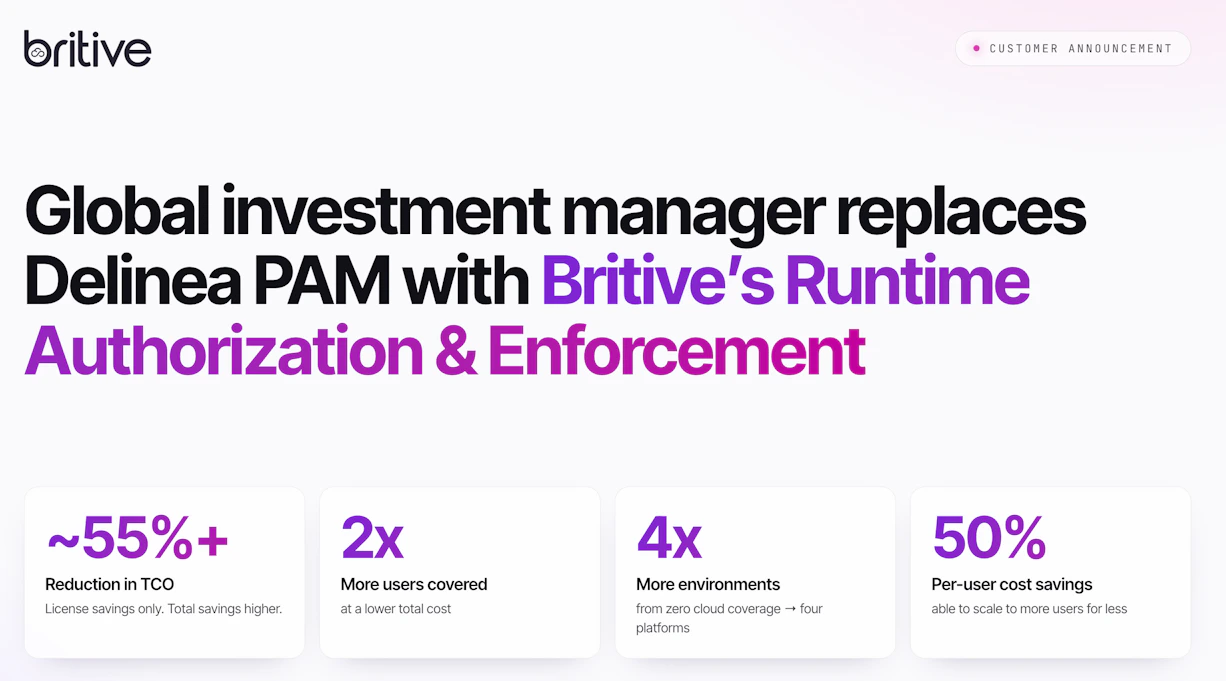
From Renewal Shock to 55% Lower TCO and Runtime ZSP
"The renewal quote from our previous vendor was the forcing function. When we saw what it would cost to properly deploy what we already had, the decision became straightforward."
- Global Head of IAM, global investment manager
When a per-user rate hike for a modest license expansion made renewing with their legacy vault provider unsustainable, this infrastructure team extended for one final year to buy time and evaluate architectural alternatives.
The Result: By shifting to a runtime control plane, they doubled user coverage, expanded from a single environment to four, and completed deployment across three Active Directory forests in weeks—all while securing access at 55%+ less than their legacy renewal would have cost.
Read the case study →Read the case study →
The Transformation Path to Britive's Modern, Cloud-Native PAM
Step 1: Identify your standing privilege blindspots.
Vault-and-proxy architectures were built for on-prem networks, so the gaps concentrate in the cloud. Audit your AWS, Azure, and GCP entitlements, SaaS admin roles, and the credentials your pipelines and AI agents hold. Anything static and always-on is your primary standing risk.
Step 2: Deploy where legacy architecture struggles the most.
Start in cloud and developer workflows, where checkout friction hurts most and Britive deploys fastest. The Terraform provider manages access policy as code; the PyBritive CLI drops into existing pipeline scripts. Engineers request access, get a token, and keep working. Zero standing privileges in the cloud, zero change to how developers work.
Step 3: Unify under a single policy engine.
With cloud and pipelines secured, extend the ephemeral model across SaaS, hybrid, and remaining on-prem environments. The end state is one architecture: human, agentic AI, and non-human identities governed by a single policy engine, with one audit trail that makes proving compliance (SOC 2, PCI DSS, DORA) continuous instead of seasonal.
Delinea and Britive, side by side
Close the architectural gap that opens with vault-based acces management.
Delinea and Britive, side by side
Close the architectural gap that opens with vault-based acces management.
Delinea
Britive
Core Architecture
Core access control relies on storing static secrets in a centralized vault and often routing sessions through proxies.
Single platform. Control plane authorization. One policy model. One audit trail. No proxy dependency.
Cloud IAM
Provides deep visibility and risk scoring for cloud entitlements, but access remediation often defaults back to vaulting static cloud credentials.
Analyzes cloud entitlements across AWS, Azure, GCP, and OCI with the ability to address over-permissioning by replacing standing access.
SaaS Coverage
Primarily manages SaaS access by vaulting shared admin credentials or relying on standard SSO/MFA step-ups.
Native JIT for all major SaaS apps, including Snowflake, Salesforce, Atlassian, ServiceNow, GitHub, and 100+ more.
Non-Human Identities
Handles NHIs by storing static API keys and service accounts in the vault, forcing automated pipelines to execute programmatic "checkouts."
First-class. OIDC federation, JIT per pipeline run, full NHI registry and lifecycle governance.
Agentic AI
Relies heavily on identity threat detection (ITDR) to flag risky or anomalous AI behavior after the access event has occurred.
Evaluates AI agent access in real time. Utilizes MCP gateway and human-in-the-loop approval for additional security enforced in real-time.
Developer Workflow
More admin focused, forces developers to break their flow, log into a PAM portal, and check out a secret from a vault before they can execute a task.
Operates seamlessly within native developer tools, including PyBritive CLI, Terraform, and kubectl. Developers request access, get a token, and keep working.
Multi-Cloud Security
Achieving deep PAM enforcement across multiple clouds requires deploying and managing proxy and vault infrastructure closer to those environments.
Grants federated, ephemeral access across AWS, Azure, GCP, and Kubernetes without deploying additional infrastructure, for reduced overhead.
Security Enforcement
Uses identity threat detection to spot anomalies, relying on alerts and automated webhooks to rotate compromised vault passwords after the fact.
Uses the Shared Signals Framework to evaluate risk continuously, instantly killing active cloud sessions mid-flight if endpoint risk is detected.
What's your current PAM stack actually covering and what's left ungoverned alongside it?
Bring your messiest access pattern: a multi-cloud pipeline, a contractor workflow, an AI agent that needs scoped permissions. We’ll show you what runtime enforcement looks like on it, live.
Schedule a personalized demo→
FAQ
Can Britive run alongside Delinea during a transition?
'%20stroke-width='2'/%3e%3cdefs%3e%3clinearGradient%20id='paint0_linear_1063_5522'%20x1='0.871795'%20y1='1.23504'%20x2='20.1122'%20y2='10.6379'%20gradientUnits='userSpaceOnUse'%3e%3cstop%20stop-color='%23CA1ECC'/%3e%3cstop%20offset='1'%20stop-color='%233E5DE0'/%3e%3c/linearGradient%3e%3c/defs%3e%3c/svg%3e)
Yes, and most migrations start that way. Britive takes runtime access for cloud, SaaS, and automation first while Delinea continues vaulting what it vaults today. Teams typically run both through a renewal cycle and consolidate when the evidence is in.
What do you mean by “ephemeral JIT access”?
Ephemeral JIT means the privilege itself does not exist until it is requested. Access is created at runtime, scoped to the task, and removed when the task ends. Nothing stands by before or after.
How is this different from traditional JIT access?
Traditional JIT limits when a credential can be used. The privileged role still exists. Britive limits when privilege exists. If the work is not happening, the privilege is not there.
How does this work with Agentic AI and autonomous workflows?
Agentic AI needs access that is dynamic, task-scoped, and short-lived. Britive treats AI agents as first-class identities and applies the same access model used for humans and automation. Privilege is created at runtime for a specific action, scoped by policy, and removed immediately after. Agents never hold standing access or long-lived credentials, even as they act autonomously.
Does this work for machine identities and automation?
Yes. The same access model and policies apply to pipelines, service accounts, and automated workflows.
Can Britive integrate with ___?
Yes! Britive is API-first and integration-friendly, allowing seamless out-of-the-box integrations with cloud infrastructure providers (AWS, GCP, Azure, etc.), SSO & Identity Providers (Okta, Microsoft Entra ID / Azure AD, Ping Identity), SIEM & Logging Tools (Splunk, Datadog, etc.) and DevOps & CI/CD Pipelines (Terraform, GitHub Actions, Kubernetes, etc.).
You can find a starting list of our integrations here.
Does Britive allow the import of privileged accounts for other systems?
Yes, Britive offers the ability to import privileged accounts from other systems for seamless integration and centralized management. Privileged accounts from cloud platforms like AWS, Azure, and Google Cloud, as well as on-premises systems, can be imported into Britive. Automated discovery simplifies the process, identifying existing accounts for streamlined integration.
Does the Britive solution offer any "break glass" access?
Yes, Britive offers "break glass" access capabilities, including support for managing emergency access to critical accounts such as AWS root accounts. This ensures operational continuity and secure access during emergencies. This includes strict access policies, logging, and enforcement of strong authentication methods for enhanced security.
Break glass access is also strictly monitored and governed by approval workflows, ensuring that usage is authorized and fully auditable.
Does Britive support session recording?
Yes, Britive's session recording capability is lightweight and easy to deploy for selective monitoring of RDP and SSH sessions.
Do I still need a vault?
Britive offers vaults where static secrets are unavoidable. For cloud and SaaS privileged access, Britive issues ephemeral privileges directly and does not depend on stored admin credentials.
What about audits and compliance?
Every request, decision, and expiration is logged. You can see who had access, to what, and for how long without reconstruction.
Does Britive support password rotation and vaulting at all?
Yes. Britive vaults and rotates credentials where static secrets are unavoidable. The difference is the default: wherever the target system supports it, Britive issues ephemeral privileges instead, so there is no credential to manage in the first place.
How does the audit story change?
Every request, decision, grant, and expiration is logged as it happens, and because access exists only while work occurs, the trail is always current. Audit prep stops being reconstruction; it becomes export.
Case studies
Britive in the Real World
001
002
003
001
002
003




Financial Services Company Streamlines Access Management
Forbes Saves Costs & Removes Standing Privileges to Align with Zero Trust Security
Fortune 500 Retail Giant Eliminates Standing Access Across Growing Cloud Footprint
7000+
54k+
67k+
30,000+
400+
< 30 min
Privileged human identities managed
Static Privileges Eliminated
Static privileges eliminated across all cloud providers
Non-human identities access managed
Identity profiles managed in GCP
Total on and off-boarding time, reduced from 3 days